

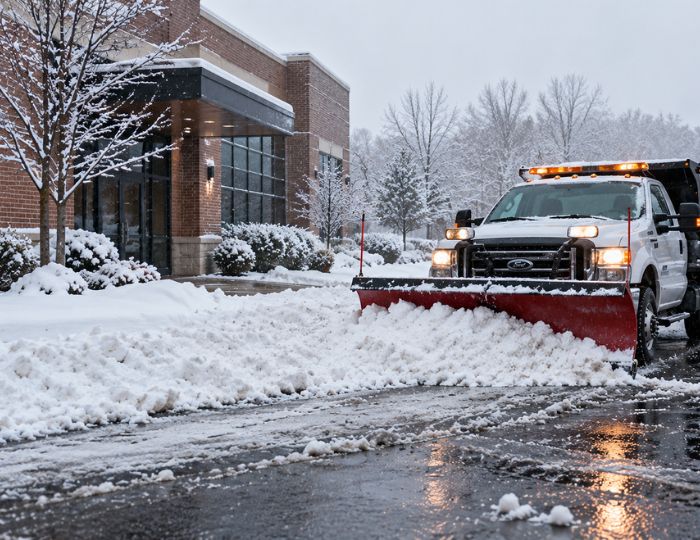
For commercial property owners and managers, winter preparation involves much more than checking the forecast.
Snow and ice can affect parking areas, sidewalks, entrances, loading zones, employee access, customer traffic, and everyday operations. Once winter weather arrives, those areas can require coordinated attention.
That makes fall an important time to walk the property, identify priorities, and establish a plan.
Seasonal Landscape Solutions provides commercial snow removal as part of its commercial property services. Preparing before winter conditions arrive can help property managers clearly identify which parts of a site matter most.
Use this checklist to begin evaluating your commercial property.
1. Identify Priority Snow Removal Areas
Every commercial property is different.
A retail center may prioritize customer parking and storefront entrances. An office complex may focus on employee parking, sidewalks, and building access. Industrial properties can have loading zones, service roads, and delivery areas to consider.
Before winter, identify the property’s most important areas, including:
- Main parking lots
- Primary entrances
- Employee entrances
- Sidewalks
- Loading areas
- Delivery routes
- Service access
- High-traffic pedestrian zones
These areas can then be incorporated into a more organized snow-management plan.
2. Evaluate Parking Lots and Vehicle Traffic
Parking areas are often among the largest spaces requiring attention during a winter event.
Look at the property from the perspective of customers, employees, vendors, and snow removal crews.
Where do vehicles enter and exit? Which lanes carry the most traffic? Are there narrow sections where parked vehicles could make snow removal more challenging?
Another important consideration is snow storage.
Large piles placed without considering the property’s layout can interfere with parking spaces, sightlines, or traffic patterns.
Thinking through those details before winter helps establish clearer expectations.
3. Walk Every Major Pedestrian Route
Once you’ve evaluated vehicle traffic, walk the property.
Start at common parking areas and follow the routes customers or employees would naturally take toward the building.
Pay attention to:
- Sidewalks
- Steps
- Building entrances
- Pathway intersections
- Narrow walkways
- Transitions between parking lots and sidewalks
Look at Your Property Like a First-Time Visitor
Property managers become familiar with every shortcut and unusual feature of their sites.
Visitors don’t have that familiarity.
Walking the property from a visitor’s perspective can reveal which routes are most intuitive and therefore deserve particular attention in a winter plan.
4. Decide Where Snow Can Be Stored
Snow doesn’t disappear when it’s pushed away from a parking space or sidewalk.
It has to go somewhere.
Before winter, identify locations where snow can accumulate while minimizing interference with normal property operations.
Consider whether a potential storage area could affect parking, pedestrian movement, visibility, landscaping, or access.
Properties with limited space may require particularly careful planning.
This is one reason Seasonal Landscape Solutions has long encouraged businesses to schedule commercial snow removal before winter rather than waiting for the first significant weather event.
5. Inspect Landscaping Around High-Traffic Areas
Commercial landscaping continues to affect how a property functions even after the growing season ends.
Look for vegetation around sidewalks, entrances, signs, parking areas, and other important access points.
Overgrown plants or poorly defined landscape areas can make winter circulation more complicated.
Professional commercial landscape maintenance can help keep the property cared for throughout changing seasons.
Taking a broader approach also helps property managers consider winter needs as part of year-round site management rather than as an isolated problem.
6. Review Snow and Ice Management Before It Becomes Urgent
A snow removal plan is easier to discuss when there isn’t already snow accumulating outside.
Before winter begins, determine which areas have the highest priority and communicate any site-specific concerns.
Seasonal Landscape Solutions has previously outlined considerations for choosing a commercial snow and ice removal company and selecting a snow removal service.
Use that preparation period to ask questions and establish expectations.
7. Think Beyond the First Snowfall
Winter planning shouldn’t focus on one storm.
Repeated snow events can change how a commercial property functions throughout the season.
Snow piles can grow. Available storage space can change. Different portions of the property may become more difficult to access as winter continues.
That’s why a good preseason assessment looks at the entire winter rather than a single weather event.
Seasonal Landscape Solutions has also discussed potential problems associated with going without snow removal services, providing additional context for businesses evaluating their winter plans.
Coordinate Winter Care With Year-Round Property Maintenance
Commercial properties don’t stop needing attention when summer ends.
Landscaping, hardscaping, pedestrian areas, parking spaces, and seasonal services are all parts of the same property.
A coordinated approach can make it easier to identify concerns before conditions change.
Businesses evaluating their overall exterior needs can explore Seasonal Landscape Solutions’ commercial property landscaping guidance alongside its snow and ice services.
The goal is to understand the property as a complete environment rather than responding to each seasonal need independently.
Prepare Your Commercial Property Before Winter Arrives
A winter-ready property begins with a simple walkthrough and a clear plan.
Identify the areas that matter most. Review how vehicles and pedestrians move through the property. Determine where snow can be stored. Inspect landscaping near important routes. Then make sure everyone involved understands the site’s priorities.
Seasonal Landscape Solutions works with commercial properties on both landscape maintenance and winter snow management. If you’re reviewing your property’s seasonal needs, contact Seasonal Landscape Solutions before winter conditions make planning more urgent.
Key Takeaways
Identify parking lots, sidewalks, entrances, loading areas, and other priority zones before winter.
Walk pedestrian routes from the perspective of employees, customers, tenants, and visitors.
Determine appropriate snow-storage areas before repeated winter events reduce available space.
Include landscaping and other exterior features in your preseason property inspection.
Coordinate snow removal planning with year-round commercial landscape maintenance for a more complete approach to property care.